
Letter of Acceptance (LOA) Canada Explained For Students
If you want to study in Canada, here is another key document you need before applying for a study permit - the Letter of Acceptance (LOA).
It’s your official confirmation of admission to a Canadian educational institution, and it serves as proof of enrollment
In this article, we'll dive into the essential details of the LOA, including its key components, why it's important, and how it plays a vital role in your journey as an international student in Canada.
What is a Letter of Acceptance (LOA) in Canada?
A letter of acceptance (LOA) is a critical document for international students issued by a Canadian educational institution, in your case, a Designated learning institution (DLI), that confirms you met all requirements for admission to their study program.
The LOA is a significant document for international students, both legally and procedurally, that confirms admission to a specific program. Your application can be rejected if you don’t have it, as it forms part of the student's official academic record.
Types of Letters of Acceptance
Canadian educational institutions can provide different types of LOAs depending on
Conditional Letter of Acceptance (CLA)
A Conditional Letter of Acceptance (CLA) is a document issued to an international student who hasn’t met all the admission requirements for the Canadian institution.
Here is what’s essential about CLA:
The CLA indicates the remaining requirements the student must meet before being accepted into the program
These requirements can vary from one institution to another, and factors that affect this can be obtaining a minimum grade point average (GPA), standardised test scores, or completion of a specific course
Moreover, a condition you should fulfil for CLA to be issued may include submitting additional documentation, if required. Just in case, it should be kept safe for future reference.
Unconditional Letter of Acceptance (ULA)
If you haven’t met all the requirements but are still accepted into DLI, you get an Unconditional Letter of Acceptance (ULA). It contains the program's start date, length, tuition fee amount, and student enrollment.
Here are the benefits of receiving a ULA for the student visa application process:
After receiving a ULA, you can apply for a student visa
With a ULA, you show proof to immigration officials that you can study in the country
Deferred Letter of Acceptance (DLA)
You receive a Deferred Acceptance Letter (DLA) if accepted into the DLI program, but your enrollment has been deferred to a future term. It specifies the conditions for postponement and the start date of the postponed period. For example, the letter can be deferred due to the necessity of completing a prerequisite course first or financial constraints.
Here’s how to proceed after receiving a DLA:
Check with DLA about verifying the new start date for your studies
Contact the institution to discuss any further steps or requirements
Start looking for suitable accommodation for your new date of arrival
Contact the relevant airlines or travel agencies to make changes to your itinerary if possible
Co-op Work Permit Letter of Acceptance (CWP)
A Co-Op Work Permit Letter of Acceptance (CWP) is a document issued to you if you have been accepted into a program of DLI and to participate in a cooperative education program.
In case you are not sure, here are the required documents for a co-op work permit application:
A valid passport
A digital passport photo
A valid study permit (it is valid for a specific academic year or semester)
A letter from your school that confirms you need to complete work placements to get your degree
Language School Letter of Acceptance (LSLA)
A Language School Letter of Acceptance (LSLA) is a document issued to you to show that you have been accepted into a language school program at a DLI. The LSLA confirms you are enrolled in the program. It provides the details of the language program, indicates the start and end dates of the program, outlines the course of study and duration, and specifies tuition fees and payment details.
The process of transitioning from a language program to a degree program in Canada includes:
Completing the language program
Applying for the desired degree program at a DLI
Receiving a Letter of Acceptance (LOA) from the DLI
Applying for a study permit
Transitioning to the degree program
What Does the LOA Canada Contain?
See below the key components included in a LOA.
Personal Information
Personal information that must be presented in a LOA are:
Students full name
Date of birth
Citizenship
Student ID or Application Number
Program Information
The program-specific details included in the LOA are:
Program name and details
If your DLI is based in Quebec, it includes your Certificat d’Acceptation du Quebec (CAQ) details
Program start and end dates
Course duration (Enrollment status -full-time/part-time)
Other relevant information (Issuing institution's name, including full name, DLI number, address, and contact information). It often contains contact information for international student offices
Financial Information
The types of financial information a LOA might contain:
Tuition fees
Living expenses
Scholarship or Funding Details (if mentioned)
Deadline
Once you have the LOA, you can apply for a study permit (student visa). The letter of acceptance must be presented for visa applications. You must comply with the institution's policy and Canadian immigration requirements, as missing the deadline may delay the visa application process, potentially affecting your ability to start your program on time.
Conditions
You must meet all the stipulated conditions of acceptance before being issued a study permit.
Some conditions include:
Submission of additional documents
Passing the language test (IELTS or TOEFL)
Contact Information
Correcting and completing the institution's contact information in the LOA is mandatory, as it can affect the application approval.
Steps to Get a Letter of Acceptance (LOA) in Canada
These are the general steps you must follow to obtain an LOA from a Canadian institution:
Fill out the application form
Apply for the study permit
Travel to Canada
In the following, look at the instructions for the next steps in detail.
Filling Out the Application Form
You should fill out the provided application form and attach documents such as transcripts, letters of recommendation, and personal statements.
Step 2: Applying for the Study Permit
If DLI accepts your application, you should apply for a student visa. Accordingly, you should submit documents, such as a passport (check a document validity period), proof of financial resources, medical exam or criminal record. Luckily, BorderPass will make that process much more manageable.
Step 3: Traveling to Canada
After you receive a study permit, you can travel to Canada.
These are the steps after obtaining the study permit:
Arrange your flight to Canada
Arrange accommodation upon your arrival
Plan a travel itinerary
Pack your stuff (documents, clothes, and all essentials)
Exemptions from the Requirement for LOA in Canada
Even though it seems the LOA is an inevitable document for studying, scenarios where it might not be necessary for studying in Canada prove that’s not always the case.
Short-Term Studies
If your chosen program lasts less than six months, you may be exempt from a letter of acceptance. But this exemption doesn’t mean there is no need for some other documents. Still, you will need a visitor visa or electronic travel authorisation (eTA), depending on your country of citizenship.
Exchange Programs
If you just came to Canada within an approved exchange program and want to explore the Canadian educational system more, you won’t need a letter of acceptance either.
Spouses or Dependents of Foreign Workers As Students
There is no need for an acceptance letter if you are the spouse or dependent of a foreign worker or student in Canada, but you will still need a study permit.
Protected Individuals or Refugees
Situations like being granted refugee status or being a protected person in Canada don’t require a letter of acceptance to study in Canada.
Letter of Acceptance Canada Sample
After going through all about a letter of acceptance, it’s time to provide a fictional sample of an LOA.
It might look like this:
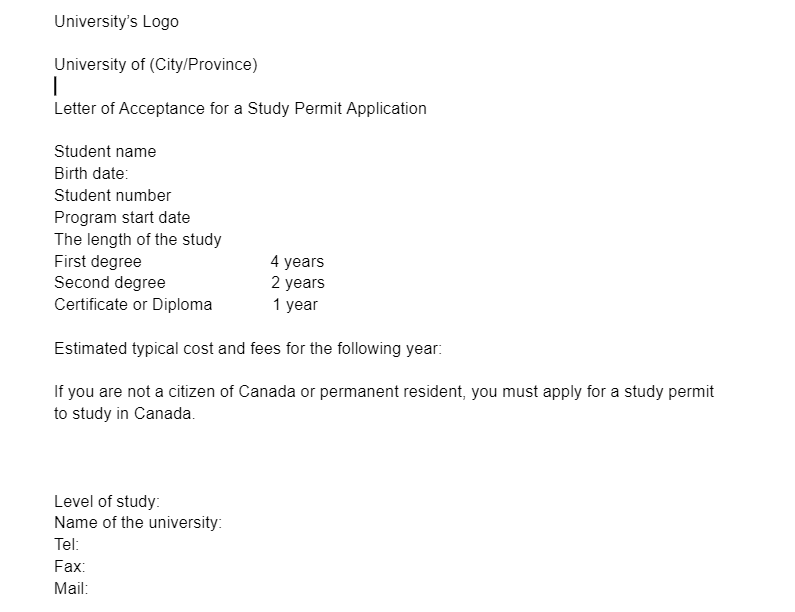
Even though these letters may differ in some elements from college to college, which is not a big difference, some elements included must provide basic information about you and your program of study.
University’s Logo - The logo of a particular institution
University of (City/Province) - Alberta, Ontario, New Brunswick, Quebec, etc.
A letter of Acceptance is required for a Study Permit Application - This is the first step in obtaining a study permit
Student name
Birth date:
Student number
Program start date
The length of the study
Estimated typical cost and fees for the following year: It depends from institution to institution
It may detail campus accommodation options
Level of study
Name of the university
Tel
Fax
Mail
Includes the institution's official seal or signature
What to Do After You Get an LOA from a Canadian DLI
The letter of acceptance is sent to successful applicants.
The first thing you should do after receiving your acceptance letter is to apply for a study permit. Then, you need to prepare to move to Canada.
Specifically, here are the steps to take after receiving an LOA:
Attach proof of financial support
Submit a Quebec Admission Certificate (CAK)
Prepare and send a statement of purpose or letter of explanation to explain to the visa officer why you want to study in Canada (if you want more about the study gap explanation letter sample)
Police certificate and medical examination results
If you are wondering about a gap accepted for study in canada after graduation, you should know a gap of 2 years is recommended for diploma and undergraduate courses, and a study gap of 5 years is acceptable for postgraduate courses in Canada.
Key Takeaways
A letter of acceptance (LOA) is an official document issued by a DLI that confirms you met all requirements for admission to their study program
There is a conditional Letter of Acceptance (CLA), an Unconditional Letter of Acceptance (CLA), a Deferred Letter of Acceptance (DLA), a Co-op Work Permit Letter of Acceptance (CWP), and a Language School Letter of Acceptance (LSLA)
Every LOA contains personal, contact, program, conditions, payment terms and deadlines
To get an LOA, you must fill out the application form then apply for a study permit, and prepare to travel to Canada
Exemptions from an LOA include short-term studies, exchange programs, spouses and dependents, and protected individuals or refugees
What’s most important, after you get an LOA, you’ll need to apply for a study permit
Frequently Asked Questions
How Long Does It Take to Get an Acceptance Letter from a University?
The general time of the issuance of the LOA from Canadian institutions can vary from college to college, but it's usually four to eight weeks after you have submitted your application.
Factors affecting the LOA issuance include your application's admission date, deadlines, insufficient documentation, or admission policies.
Does Having an LOA Guarantee You Will Get a Study Permit?
A LOA is an integral part of the process of getting a study permit. However, other things such as documentation, financial resources, and required tests may affect obtaining a study permit. Having an LOA is a considerable condition but not a guarantee.
Do You Need an LOA to Extend Your Study Permit?
Since your LOA is only valid for a limited time and, if your study permit is not processed within that time, you must ask your DLI for an extension and submit additional documents to IRCC.
If you plan to extend your stay in Canada and continue your studies, apply for admission in advance, as you will need an LOA and proof of payment as you plan to attend a new study program For your information, it can be requested again if lost or damaged.