The National Picture: A Reset Year Meets a Recovery
The first four months of 2026 confirm that Canada's study permit system is operating at a structurally smaller scale than a year ago. IRCC processed 69,305 decisions between January and April 2025; the same period in 2026 produced 39,245, a decline of 43 percent. At the same time, outcomes have strengthened considerably:
the early 2026 approval rate of 35 percent is 9 points above the same period last year and already matches the full-year 2025 rate of 35 percent.
MONTHLY DECISIONS PROCESSED • APPROVAL RATE, 2025 VS. 2026
Month | Dec '25 | Dec '26 | Rate |
|---|---|---|---|
January | 27, 285 | 10, 465 | 22% to 31% |
February | 14, 130 | 7, 765 | 28% to 29% |
March | 12, 615 | 9, 100 | 28% to 37% |
April | 15, 275 | 11, 915 | 30% to 42% |
January 2025 was an outlier month, with 27,285 decisions processed as IRCC worked through the backlog that preceded the provincial attestation regime. Setting January aside, the monthly gap between years narrows steadily, and April 2026 volumes reached 78 percent of April 2025 levels while approving at a rate 13 points higher. The 2026 approval trajectory has climbed each month since February, reaching 42 percent in April.
Provincial Trends: The Contraction Is Not Evenly Shared
Every province processed fewer decisions in early 2026 than in the same period of 2025, but the depth of the decline varies widely. The figures below aggregate institution-level IRCC data by province, covering over 99 percent of national volume in both years, and compare approval rates across January–April 2025 vs. January–April 2026.
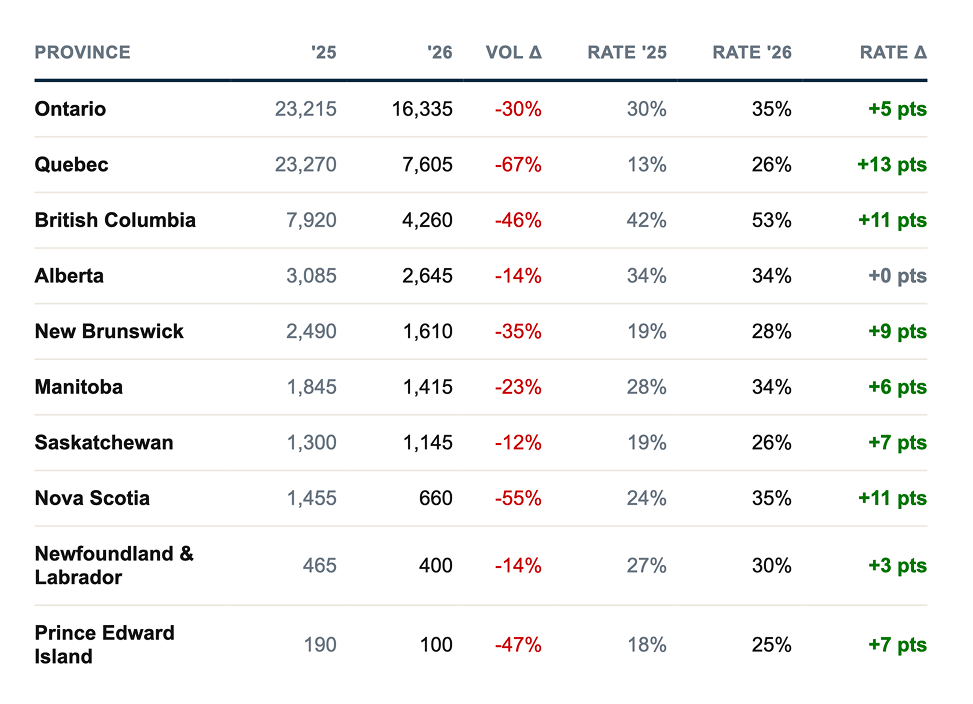
Quebec stands apart: volumes fell 67 percent year over year, by far the steepest provincial decline, yet its approval rate roughly doubled from 13 to 26 percent. The decline is real rather than a reporting artifact, and it is concentrated: a small group of private colleges that processed thousands of applications in early 2025 collapsed to a fraction of that volume in 2026, and the number of Quebec institutions with visible processing activity fell from 119 to 79. The comparison is also inflated by January 2025, when Quebec accounted for roughly 39 percent of the national backlog-driven processing surge. BorderPass is now fully operational across Quebec institutions, with a dedicated sales and immigration team on the ground to support partners as the province's intake stabilizes. British Columbia remains the approval rate leader among large provinces at 53 percent, though its volumes fell 46 percent, the second-steepest decline, reflecting its exposure to the private career college segment. Ontario, now over 40 percent of national volume, declined a more moderate 29 percent while gaining ground on approvals. Alberta, Saskatchewan, and Newfoundland and Labrador held volumes closest to 2025 levels, each declining less than 15 percent, and may be absorbing some demand redirected from provinces with steeper cuts. Every province held or improved its approval rate year over year.
Key Source Markets: Diverging Paths
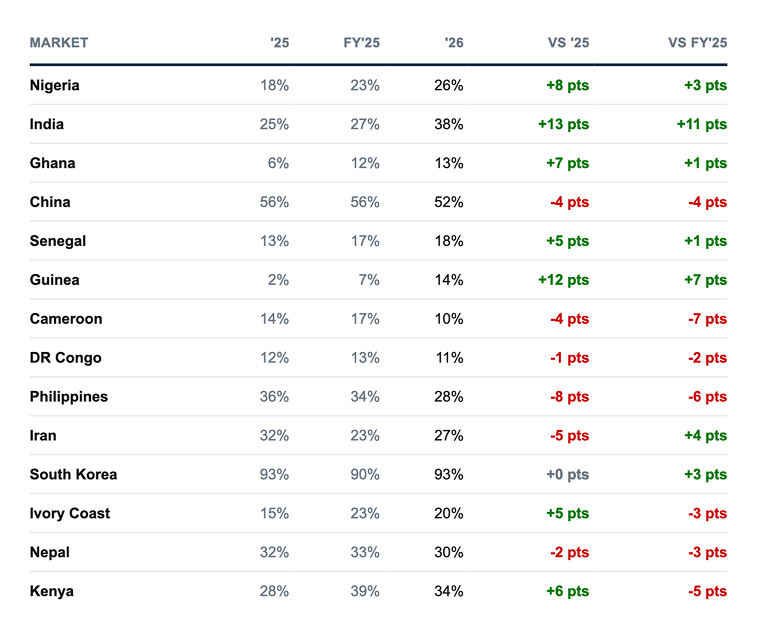
Approval trends across source markets are moving in clearly different directions. The table compares each market's approval rate across January–April 2025, full-year 2025, and early 2026, among the top source markets by early 2026 processing volume. Gains appear in green, declines in red.
For the first time, Nigeria has overtaken India as Canada's top study permit source market
On publicly available figures, Nigeria appears to have surpassed India in study permit processing volume in early 2026. It reflects both India's sharp volume reset and Nigeria's resilience through the contraction, and it reshapes where recruitment attention and application-quality investment will matter most for the rest of the year.
South Asia leads the approval recovery: the typical institution's India rate sits 10 points above the full-year 2025 national mark and 13 points above the same period last year, with Bangladesh up even more sharply and Nigeria also improving on both comparisons. Several established markets are moving the other way; Cameroon, DR Congo, the Philippines, Nepal, and Kenya are all tracking below their full-year 2025 rates, extending a pattern where early-year periods run weak for several of these markets.
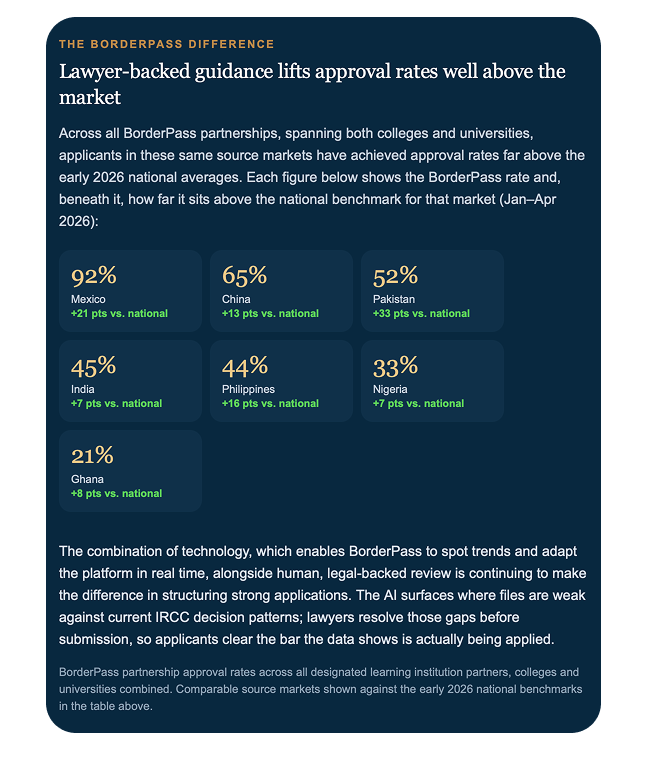
Universities vs. Colleges: A Persistent and Widening Gap
Across every key source market, university applicants continued to outperform college applicants in early 2026. Among all universities and colleges with publicly visible IRCC data, the typical university's India approval rate is more than double the typical college's, and there is no key source market where colleges match or exceed university approval rates.
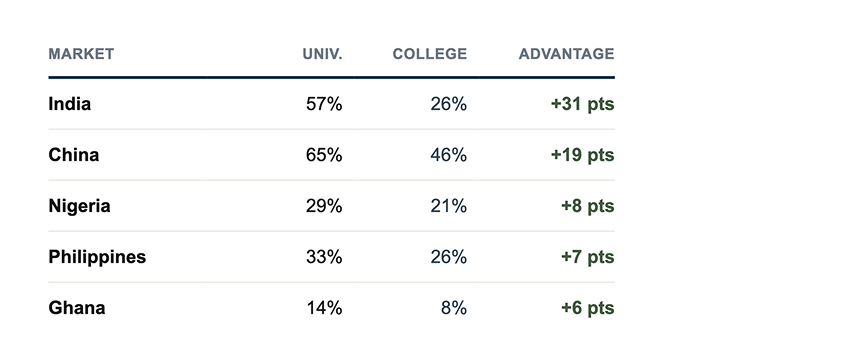
Based on publicly available data, India remains the defining gap for the college sector: the typical university approved Indian applicants at 57 percent in early 2026 against 26 percent at the typical college, a 31 point spread on the two sectors' largest shared market. The pattern holds in China, Nigeria, Ghana, and the Philippines, and it compounds the consolidation trend elsewhere in this report: as volume concentrates and scrutiny tightens, program level itself has become one of the strongest predictors of approval. College-sector institutions can respond through file quality, financial documentation standards, and applicant profile-vetting well before submission.
Based on all designated learning institutions classifiable as universities or colleges with publicly visible IRCC data for January–April 2026, by country of residence.
Beneath the Headline: Three Structural Shifts
The volume decline and the approval recovery are connected. Three patterns in the early 2026 data help explain what is changing in the composition of Canada's applicant pool.
The applicant pool is self-selecting toward stronger files Approval rates held or improved in every province and rose in the largest source market, India, at the same time as volumes fell. Where volumes fell hardest, in Quebec, rates improved most. This is consistent with heightened scrutiny doing its work: tighter policy settings and stricter financial documentation requirements are filtering weaker-profile applications out of the system, leaving a pool that succeeds more often. The monthly trajectory reinforces this: the national approval rate climbed from 31 percent in January to 42 percent in April 2026.
Source market mix now defines institutional outcomes High-performing markets such as South Korea, France, and Japan continued approving above 90 percent in early 2026, while several West and Central African markets fell to between 10 and 15 percent, stretching the spread between the top and bottom of the table past 80 points. At that distance, two institutions with comparable programs and admissions standards can post very different approval rates on recruitment mix alone. Approval rate benchmarks are only meaningful when adjusted for the markets an institution actually recruits from.
Processing is consolidating among fewer institutions The number of institutions with visible processing activity fell from 331 in early 2025 to 235 in early 2026, a 29 percent reduction. The pullback is concentrated in the private college segment, most visibly in Quebec, where several institutions that each processed hundreds or thousands of applications in early 2025 have largely exited the intake. Volume is consolidating toward public DLIs and established universities, which may make institutional track record an increasingly important factor in how markets and recruitment partners direct applicants.
Looking Ahead: Planning for the Rest of 2026
If the early 2026 pattern holds, institutions should plan for a year in which fewer applications convert at higher rates. The rising monthly approval trajectory suggests the full-year 2026 rate may finish above 2025's 35%, even as total processed volume lands well below last year. Enrolment planning built on 2023 or 2024 volume assumptions will overshoot; planning built on conversion quality is better matched to the current system.
Market strategy matters more in a smaller system. South Asian markets are converting meaningfully better than a year ago, and diversified recruitment into East and Southeast Asia continues to reward institutions with high and stable approval rates. Francophone African markets remain strategically important for many institutions, particularly in Quebec and Atlantic Canada, but their early 2026 approval rates call for careful applicant preparation, strong financial documentation, and realistic volume expectations rather than withdrawal from these markets.
Provincial context should inform institutional benchmarks. An institution's approval rate can only be fairly assessed against its province and market mix: a Quebec institution at 30 percent is outperforming its context, while a British Columbia institution at the same rate is underperforming.