
The Trade Picture
Minister Vic Fedeli opened the main stage with figures that put the stakes in plain terms. Ontario’s trade with the United States totals $500 billion annually — approximately 80% of the province’s total trade. Ontario alone is the third-largest trading partner of the United States, ranking behind only China and Mexico. That concentration reflects decades of economic integration, but it also represents a structural vulnerability that the province is actively working to reduce.
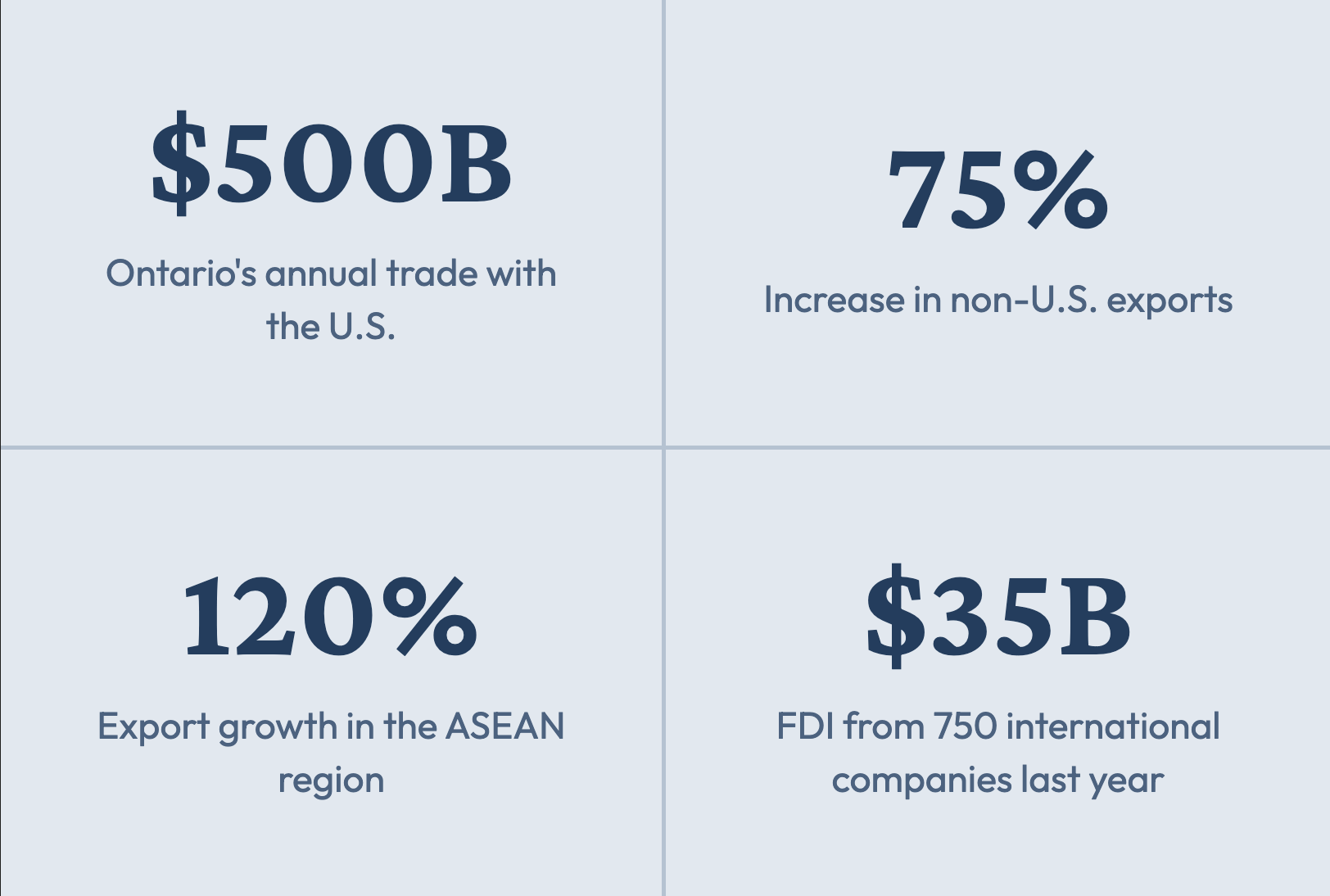
The diversification effort is producing results. Minister Fedeli’s team has conducted 85 trade and investment missions across 31 countries in the past 12 to 18 months. Non-U.S. exports are up 75%, with the ASEAN region recording a 120% increase. Last year, 750 international companies invested $35 billion in Ontario, creating thousands of jobs. The signal from global markets, he said, is clear: the province’s offer is resonating.
“The diversification message is resonating with Ontario industry.” Minister Vic Fedeli, Ontario Minister of Economic Development, Job Creation and Trade
Winning the Investment and Keeping It
Attracting international capital is one challenge. Retaining it is another. A well-documented pattern in Ontario’s health technology sector illustrates the risk: 60% of health tech companies are required to relocate to the United States for clinical validation and regulatory approval. Most do not return. Their intellectual property, ownership, and growth trajectory become American stories rather than Canadian ones.
The implications reach well beyond health tech. When companies leave for regulatory validation and do not come back, Ontario loses the compounding returns of retained innovation — the patents, spinoffs, talent networks, and tax base that follow technology leadership over decades. Addressing the regulatory friction that forces this outflow is not a secondary concern; it is central to whether the investment wins of today translate into durable economic strength.
Dan Weber drew a direct line between this challenge and BorderPass’s role in the ecosystem. “Every international company that chooses Ontario still has to navigate the complexity of moving people across borders,” he said. “If that process is slow, uncertain, or prohibitively expensive, it becomes a reason not to come — or a reason to leave. Workforce mobility is a regulatory hurdle that sits right in the middle of Ontario’s FDI story, and it’s one we can actually solve.”
The Labour Equation
Every investment story told at the Summit eventually leads back to the same constraint: people. Ontario’s birth rate sits at approximately 1.25 children per woman, well below the 2.1 replacement rate. The math is straightforward. Both domestic companies scaling in the corridor and the hundreds of international firms that chose Ontario last year will need immigration to fill the labour gaps that demographics alone cannot close.
Darrell Bricker of Ipsos, and a Senior Fellow at the Centre for International Governance Innovation (CIGI), reinforced this from a research perspective. Immigration is not peripheral to Canada’s innovation capacity — it is central to it. The talent that anchors the next generation of Ontario-based companies will increasingly come from abroad. The critical question is whether the systems governing arrival, work authorization, and the path to permanent residence can keep pace with the speed at which companies need to hire.
“Immigration is critical to innovation.” Darrell Bricker, CEO, Ipsos
Regulatory complexity remains one of the most frequently cited deterrents for international companies considering Canadian investment. Compliance friction at the border — whether for goods or for people — does not appear in a headline, but it appears in decisions. Companies weigh the cost and predictability of moving talent before they commit capital.
“The companies that are making Ontario their home need to know they can bring in the people they need, on the timelines they need them. Right now, that process carries too much uncertainty and too much cost. That’s the gap BorderPass was built to close.”
Dan Weber, Head of Public Affairs, BorderPass
Education, Industry, and the Talent Pipeline
A recurring theme across the Summit’s discussions was the need for Ontario’s post-secondary institutions to align more tightly with the workforce needs of the companies choosing to invest here. Minister Fedeli echoed Premier Ford’s standing message: deans should be meeting with leading employers regularly, asking directly whether curricula still reflect what industry requires. The corridor’s long-term strength depends on producing graduates who are ready to contribute from day one in the sectors driving growth.
Workforce readiness and workforce mobility are two sides of the same coin. A curriculum that builds the right skills still fails if the immigration pathway for a specialized researcher or senior engineer is slow, unpredictable, or inaccessible to smaller employers who lack dedicated immigration legal teams. Bridging that gap requires infrastructure that removes the complexity — not just for global enterprises, but for the growing companies in Waterloo, Hamilton, and across the corridor that are competing for the same international talent.
The BorderPass Role in Ontario’s Growth Story
BorderPass is built for exactly the moment Ontario is in. As hundreds of international companies deepen their commitment to the province, and as domestic innovators compete globally for specialized skills their local labour market cannot supply, the immigration process sits as one of the most persistent and least-solved regulatory barriers to growth.
The BorderPass platform handles the legal and procedural complexity of workforce mobility end-to-end — making immigration support simpler, compliant, and cost-effective for employers of every size. Unlike traditional immigration legal services, which are expensive, slow, and difficult to scale, BorderPass’s AI-native approach brings the intelligence and efficiency of modern technology to a domain that has long resisted it. Employers can move faster on hiring decisions, stay ahead of compliance obligations, and support workers through every step of their path to permanent residence — without the cost and uncertainty that have historically made international hiring a last resort rather than a first option.
Ontario is doing the hard work of diversifying its trade relationships and attracting the world’s best companies. BorderPass helps ensure those companies can staff up, stay compliant, and build their futures here.
The Summit’s through-line was clear: Ontario has the assets, the track record, and the political will to compete for global talent and capital at scale. The infrastructure that supports workforce mobility — immigration pathways that are fast, predictable, and accessible to companies of every size — is not a back-office concern. It is a front-line competitive advantage. For the Innovation Corridor to deliver on its potential, that infrastructure needs to be as capable as the region it serves.